 One of the goals of Machdyne is to create computers and tools that will be useful long into the future, even, or especially if the future is some sort of computing dystopia, from the human perspective.
Survival computing is an extreme form of timeless computing that lets you compute, or interact with computers, when you have very limited access to modern technology or resources.
We are generally optimistic about the future so instead of an urgent necessity we usually view survival computing as more of a thought experiment where we don’t take for granted that inexpensive computation will always be available or that we will have access to plenty of electricity, or to the Internet.
There are also places on Earth today where computers are not readily available or access to them is limited due to lack of resources. People can benefit today from low-cost low-power computers even without the latest technology or the latest applications.
In the event that such a scenario were to become a reality for everyone, due to war, natural disaster, legislation, AI, or for a number of other reasons, it would be good if some preparations had been made in order to preserve access to computation and critical information.
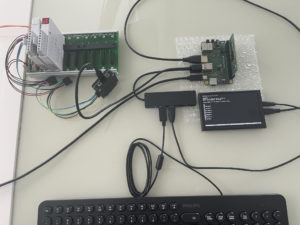 We think that timeless computers will play an important role in survival computing by ensuring access to timeless applications thanks to the benefits of FPGA computing. In addition to timeless applications it will be important to be able to interface with other systems. For example, a customer shared with us this photo of Mozart and Werkzeug connected to an industrial control system.
Thinking about survival computing has led us to many projects, here are some ideas inspired by survival computing that we’re experimenting with:
- Stahl and Blaustahl are storage devices that can potentially retain data for centuries
- Notnagel is a battery-powered handheld FPGA computer with a built-in display
- Glasur is a stand-alone front-panel computer that can be powered by a solar panel
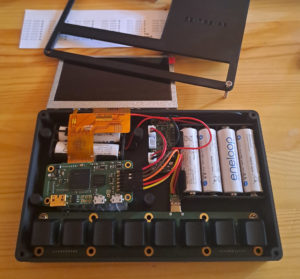
- Zeitreise is a minimalist battery-powered Linux-capable cyberdeck
- RAD5 is a stand-alone USB-powered hex editor and serial terminal
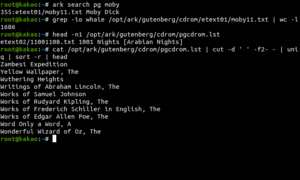
- Ark is an information distribution for offline computers
- Tidegrow is an open-source low-power automated hydroponics project
Whatever the future holds we find it interesting to think about the possibilities and to do what we can now to prepare for Things to Come.
Thanks for reading. You can follow us on X and GitHub for the latest updates.
 Deep thinking often requires writing. The writing down of thoughts can be affected by perceived privacy. Thus, the erosion of perceived privacy may reduce the capacity for deep thought.
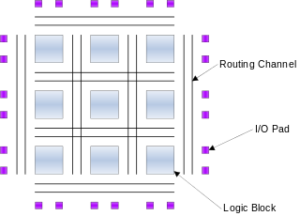 An FPGA (field-programmable gate array) is a chip that contains an array of programmable logic blocks. Together, these logic blocks can be configured to act as various digital circuits. FPGAs often have thousands of logic blocks that allow them to act as complex circuits, such as a CPU and a chipset, also known as a System-on-a-Chip (SoC).
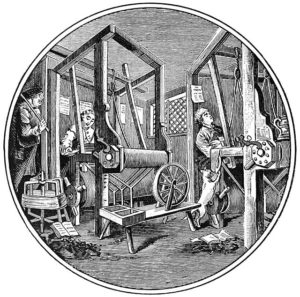 We decided earlier this year to temporarily slow down PCB design and production in order to build a pick-and-place machine. Manual PCB assembly can be a tedious, repetitive, time-consuming and sometimes stressful process and we were spending most of our time assembling boards. We determined that at least partially automating the assembly process was the only sustainable way to continue producing products ourselves.
 Machdyne began in 2021 as the experimental hardware division of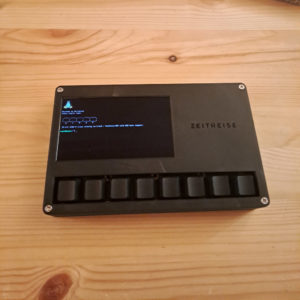
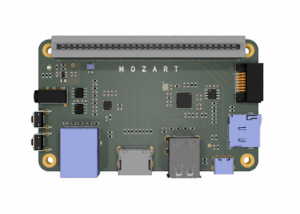
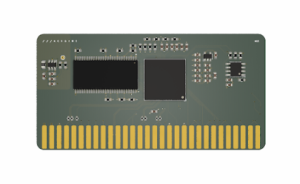
 One of our primary motivations for building
  Timeless (adj.) not affected by the passage of time or changes in fashion
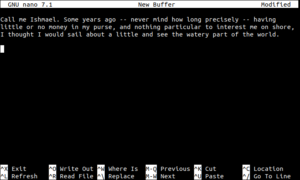 Writing. Kakao includes nano, a “small and friendly” text editor. Combined with automated backups to a secondary storage device (for example a USB drive) a writer can be productive in a secure, private and distraction-free environment.
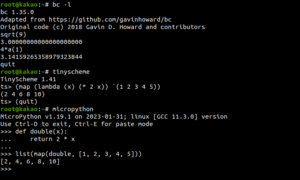 Math & Coding. Kakao includes the vi text editor, MicroPython and TinyScheme. Whether you’re a beginner or an expert you could easily spend hundreds of hours experimenting with algorithms and improving your skills using these three programs alone.
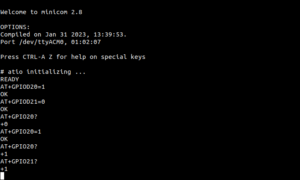 Automation. When combined with a
 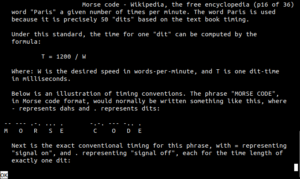 Survivalism. Our computers are built to last, simple enough to understand and repairable with common inexpensive electronics equipment. The extremely low power requirements make it feasible to run them off battery or solar power and our
  Education. Our computers are perfect for learning and teaching about computing, programming, SOCs, CPUs, FPGAs, digital logic and a lot more. The